Climate Scorecard - The Labour Party
| Climate Target | Status |
|---|---|
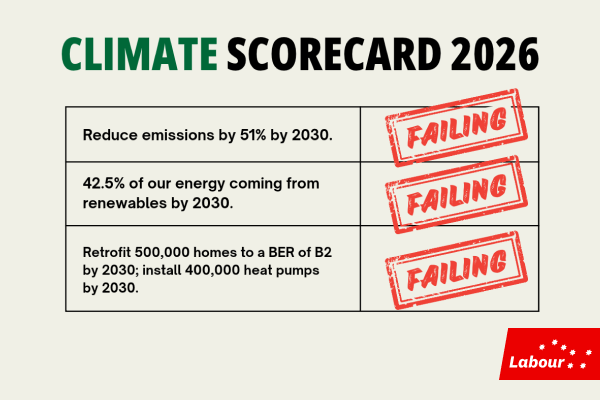
| Emissions
Target: Reduce emissions by 51% by 2030. Reality: The Environmental Protection Agency projects a 25% reduction in emissions by 2030 providing Ireland delivers on all current commitments, missing our target by more than half. |
FAILING ↗ |
| Renewable Energy
Target: 42.5% of the energy we use comes from renewable energy by 2030. Reality: We stood at 15.2% in 2024 and are projected to miss the 2030 target by 12 percentage points, according to Ireland’s own National Energy and Climate Plan. |
FAILING ↗ |
| Retrofitting
Target: Retrofit 500,000 homes to a BER of B2 by 2030; install 400,000 heat pumps by 2030. Reality: According to SEAI, they have completed 85,085 retrofits from 2018 to 2025, less than a fifth of the target in more than half of the associated timeframe; and 18,765 heat pump installations, less than 5% of the target in more than half of the associated timeframe. |
FAILING ↗ |
| Public Transport
Target: Increase public transport journeys by 130% per day by 2030. Reality: Between 2018 and 2024, half the associated timeframe, public transport journeys only increased by 23.7%, significantly off track. We know that public transport fare increases will reduce passenger numbers. |
FAILING ↗ |
| Electric Vehicles
Target: Get 175,000 private electric vehicles on the road by 2025, and 845,000 by 2030. Reality: We have met the 2025 target, but will fall short of the 2030 target because the rate of take up has slowed. In an optimistic scenario, the EPA projects 640,750 electric vehicles on the road by 2030. |
FAILING ↗ |
| Climate Adaptation and Resilience – Floods
Target: Complete climate change adaptation plans for 43 flood relief schemes by end 2027. Reality: This target was subsequently revised to 2029 as the 2027 target was determined to no longer be feasible. |
FAILING ↗ |
| Recycling
Target: Increase the plastic packaging recycling rate to 50%, and the municipal waste recycling rate to 55%. Reality: These targets have already been missed, as they were set for 2025. The EPA put us at 30% for plastic packaging and 42% for municipal waste. |
FAILING ↗ |
| Nature and Biodiversity
Target: Achieve an afforestation rate of 8,000 hectares per year. Restoration measures to cover at least 20% of land and sea areas by 2030. Reality: We have never met the 8,000 hectares target. We only planted 2,527 hectares in 2025; the afforestation rate has been declining since 2016. We are not on track to meet the restoration measures target, with under 10% of our marine areas and only 13.2% of our land area under protection. Moreover, the EU has challenged the adequacy of these protections. |
FAILING ↗ |
| District Heating
Target: Generate 2.7 TWh of energy a year via district heating by 2030. Reality: The EPA project this being achieved by 2040 with only 0.2TWh/yr in place by 2030. |
FAILING ↗ |
| Energy Demand
Target: Increase energy demand flexibility to 15-20% by 2025 and to 20-30% by 2030. Reality: The CRU have reported flexibility of 5% in 2025, with it projected to grow to 10% by 2030. |
FAILING ↗ |
| Food Waste
Target: Reduce food waste by 50% by 2030. Reality: Between 2023 and 2024, the EPA reported a food waste reduction of 2%, putting us far off target for both the EU (20%) and Ireland’s own (50%) targets. Recently the government has only been referencing the EU targets, not the 50% target from the National Food Waste Prevention Roadmap. |
FAILING ↗ |
| Water Quality
Target: Restore the quality of all bodies of water to at least ‘good’ status by 2027. Reality: According to the Environmental Protection Agency, of the 1,649 water bodies in Ireland not in good quality, only 150-300 will be brought up to standard by 2027. |
FAILING ↗ |
| Air Quality
Target: Achieve the new EU standards by 2030. Reality: While we are currently meeting most of the EU’s air quality targets, we are not on track for meeting the stricter 2030 targets. |
FAILING ↗ |
Additional information on targets.
Emissions
We have committed to a 51% reduction in greenhouse gas emissions, which includes carbon, by 2030. The start point for this reduction is 2018. We have a further target of achieving net-zero emissions by 2050 at the latest. The Environmental Protection Agency projects a 25% reduction in emissions by 2030 providing Ireland delivers on all current commitments, missing our target by more than half.
Breaking down the emissions target, the government set emission ceilings for seven sectors: agriculture, industry, electricity, transport, residential built environment, commercial built environment, and other (F-gases, waste, and petroleum). Each of these sectors is projected to exceed their ceiling. No ceiling was set for the land use, land use change, and forestry sector, although Ireland is unlikely to meet the EU target for this sector and in fact emissions in this sector are projected to increase.
Renewable Energy
The target of 42.5% renewable energy by 2030 comes from the EU. In 2023 we were at 16.1%, not on track to reach 42.5% but also at the EU baseline mark of 16% that we are required to maintain. We disimproved to 15.2% in 2024, below the EU baseline. According to the government’s own figures, we are projected to miss the 2030 target by 12 percentage points.
Ireland set a target of 80% renewable electricity generation by 2030 and we may meet that; we reached 50% in 2025. One of the risks to meeting that target is the fact that the growth of renewable’s share of electricity has slowed since 2020 and may be further displaced by any expansion of data centres, creating far larger electricity demands that the renewable sector cannot keep pace with. Demand for electricity is expected to increase by 61-69% between 2018 and 2030. Data centres were responsible for 88.2% of the increase in Ireland’s electricity demand from 2015 to 2024. Electricity demand increased by almost 900GW in 2025 alone. The 2024 Climate Action Plan had committed to a 10% reduction in fossil fuel demand by 2030.
If renewable energy is funnelled into data centres, this will stymie progress in meeting sector-specific renewable share targets. The share of renewable energy used in heat in Ireland is supposed to reach 24% by 2030, but it has only increased by 2.7% over eleven years to reach 7.9% by end of 2024. We are well off trajectory to meet this target and the expansion of data centres threatens further progress. We are also off target to meet the more modest EU target of 15.8%, exposing us to fines.
Breaking down our renewable energy targets, we have committed to delivering 9GW of onshore wind, 8GW of solar energy, 5GW of offshore wind, 5.7TWh of biomethane gas and 2GW of hydrogen production by 2030. Ireland achieved 4GW of solar energy in 2025, and is predicted to meet that target. We are predicted to reach 7.5GW of onshore wind by 2030, missing that target by 1.5GW. We are far behind in the development of offshore wind, biomethane, and hydrogen production. Regarding offshore wind, we are projected to reach merely 824MW by 2030. Serious concerns have been raised regarding delays in this area. We will only meet our hydrogen production target if we meet our offshore wind target. Regarding biomethane production, the SEAI has projected that Ireland could produce 5.1TWh only with significant land use change, still below the government target. With current resources we could produce 3.7TWh. Biomethane production declined in 2025 and 2024 compared to 2023, which was attributed to equipment issues on one specific site, demonstrating that the still young sector has not yet found its footing.
It is widely acknowledged that adoption of renewable energy technology is not enough to meet climate targets; energy use overall must reduce as well. The Energy Efficiency Directive set a target of 13% reduced energy use by 2030 relative to 2022 levels. Ireland is expected to miss this, with energy use exceeding the target by 21%.
Retrofitting
The National Residential Retrofit Plan (NRP) aims to retrofit 500,000 homes to a BER of B2 by 2030, and install 400,000 heat pumps by 2030. These targets are measured from a start date of 2018. According to SEAI, they have completed 85,085 retrofits from 2018 to 2025, less than a fifth of the target in more than half of the associated timeframe; and 18,765 heat pump installations, less than 5% of the target in more than half of the associated timeframe. A recent review estimates that we are two years off our retrofit targets and twelve years off our heat pump targets.
Measuring the rate of retrofit will be complicated by anticipated changes to the BER system at the EU level. Rates of retrofitting have been increasing, but it is likely this increase will prove unsustainable, as we run out of easy to reach, easy to complete homes.
Public Transport
The Climate Action Plan set a target for 2025 of 125,000 additional public transport and active travel journeys, rising to 500,000 by 2030. This is broken down as a 50% increase in active travel journeys (walking and cycling) and 130% increase in public transport journeys. This is using a base level of 2018. According to the final National Sustainable Mobility Policy Progress Report, between 2018 and 2025, just over half the associated timeframe for the 2030 target, public transport journeys only increased by 35.1%, significantly off track. This excludes commercial bus journeys, which in fact declined by 17.9% between 2018 and 2024. Budget 2026 provided no funding for new public transport projects, casting doubt any future significant growth in uptake. A 50% increase in active travel journeys by 2030 implies 28% of all journeys being active; this is in reach. The figure for 2024, after half the associated time frame, was 20%.
According to CSO figures, public transport across public bus, rail, and LUAS journeys, increased by only 17.9% from 2018 to 2024 (from 316.5 million annually to 373.2 million). With figures up to 2025, there has been a 15% increase in rail journeys since 2018 and a 32% increase in LUAS journeys since 2018. The figures for bus journeys in 2025 are not yet available.
As mentioned in the electric vehicle section, we are also off trajectory for meeting our 2030 target of 1,500 electric buses in the Public Service Obligation bus fleet – we were at 308 in 2025, growth of only 26 compared to the 282 of 2024.
Electric Vehicles
Ireland set targets of 175,000 private electric vehicles on the road by 2025, and 845,000 by 2030. We have met the 2025 target, with government reporting 196,000 electric vehicles in the fleet that year, but are predicted to fall short of the 2030 target. CSO figures that exclude hybrids and only look at fully electric vehicles put the number in June 2026 at 134,475, or 4% of the total fleet. There has been insufficient interest in the Zero Emissions Heavy Duty Vehicle Grant to draw down all available funds in 2024 and 2025. A very small fraction (often less than 1 in 100) of new heavy duty vehicles are zero emissions. In an optimistic scenario, the EPA projects 640,750 electric vehicles on the road by 2030.
As mentioned in the public transport section, we are also off trajectory for meeting our 2030 target of 1,500 electric buses in the Public Service Obligation bus fleet – we were at 308 in 2025, growth of only 26 compared to the 282 of 2024.
Climate Adaptation and Resilience – Floods
Achieving climate resilience by no later than 2050 is a key element of the National Climate Objective, and floods are one of the identified major climate risks facing Ireland. The government has never set a target for flood relief schemes, completion of which currently takes an average of eleven years. The OPW has a five year programme of works spanning from 2023-2027, and by end 2023 they had completed one of the targeted scheme adaptation plans for completed flood relief schemes. They had set a target of completing all 43 by end 2027, but this has since been revised to 2029 as the 2027 target was determined to no longer be feasible. The 2029 figure was included in the draft Climate Change Sectoral Adaptation Plan for Flood Risk Management 2025- 2030.
In general specific targets related to adaptation and resilience are strikingly absent from Irish climate policy. There are no targets for preparedness to deal with drought or wildfires resulting from high temperatures and lack of rainfall. The aims set by our government, including in the Sectoral Adaptation Plans, are not meaningfully measurable. The Climate Change Advisory Council has advised, “The policy landscape should be based on climate resilience targets that result in transformative and significant actions,” and that “Actions [related to adaptation and resilience] need to be specific, measurable and targeted.”
Waste and Recycling
The EU set targets for 2025 to increase the plastic packaging recycling rate to 50%, and the municipal waste recycling rate to 55%. The EPA found we were at 30% for plastic packaging and 42% for municipal waste. We missed our target by 400,000 tonnes of recycling. The rate of packaging waste generation has grown almost four times faster than recycling since 2016.
We are likely to miss targets going into the future as well. The Circular Economy Act is due for adoption at the EU level in 2026, and will set a target of 24% for the circular material use rate by 2030, which refers to the proportion of material used in the economy that is recycled waste. Ireland’s circular material use rate was 2.3% in 2023, meaning we would have to increase it ten times over in seven years, where there had been very little growth in the preceding decade. Moreover, Ireland’s Circular Economy Strategy 2026-2028 sets a target of only 12% by 2030.
Nature and Biodiversity
The Climate Action Plan set an afforestation target of 8,000 hectares per year. We only planted 2,527 hectares in 2025. The afforestation rate has been declining since 2016, and in each year from 2007-2016 we planted at least 6,000 hectares.
The Climate Action Plan committed to rehabilitating 500 hectares of peatland by end 2025, which has been delayed due to “limited capacity,” apparently a concession that work in this area has not been adequately resourced. There is also a target of 30,000 hectares additional to that being rehabilitated by BnM by 2030; presumably we are significantly off track if we failed to meet the 2025 target of 500ha. However we cannot say as even the report evaluating how much progress we have made toward this goal, the publication of which is another Climate Action Plan commitment, has been delayed.
The EU’s Nature Restoration Law has set a target for restoration measures to cover at least 20% of land and sea areas by 2030. Ireland is not on track to meet these targets, with under 10% of our marine areas and only 13.2% of our land area under protection. Moreover, the EU has challenged the adequacy of these protections and 90% of these areas are in decline. Under the CAP Ireland has a target of reaching 7.5% of land area used for organic farming by 2027, on the road to 25% of EU land being used for organic farming by 2030, but we were at 5.5% in 2025. There are currently no binding targets regarding soil quality, but Ireland’s soil is unhealthy and on the decline.
Despite recommendations of the Citizen’s Assembly on Biodiversity, the Biodiversity Action Plan sets no meaningful, measurable targets.
District Heating
The 2021 Climate Action Plan set a target for district heating of up to 2.7 TWh/yr by 2030, which the ESRI found is unlikely to be met. The EPA project it being achieved by 2040, with only 0.2TWh/yr in place by 2030. While this is not a target, the SEAI found district heating could generate 50% of Ireland’s buildings’ heating demand. Legislation for the regulation of district heating has been significantly delayed, as has expansion of pilot schemes, which the Climate Change Advisory Council has described as ‘disappointing’.
Energy Demand
The Climate Action Plan 2023 set a target of increasing energy demand flexibility to 15-20% by 2025 and to 20-30% by 2030. However the CRU have reported flexibility of 5% in 2025, with it projected to grow to 10% by 2030. There is also serious concern about how Ireland is achieving energy demand flexibility – rather than shifting energy use to off-peak times, there is high reliance on Demand Side Units, large energy users, being requested by the grid to reduce their energy use at certain times. They often accomplish this through on-site generation with high emissions.
Food Waste
The EU has set a binding target of reducing food waste by 30% per capita at retail and consumption level by 2030. The Irish government through the National Food Waste Prevention Roadmap set a more ambitious target of reducing it by 50% by 2030, in line with the Sustainable Development Goals. Between 2023 and 2024, the EPA reported food waste reduction of 2%, putting us far off target for both the EU and Ireland’s own targets. The National Food Waste Prevention Roadmap elapsed in 2025 and has not been replaced, though a draft successor maintains the 50% target. Food waste generates 8-10% of global greenhouse gas emissions, making it a crucial area of climate action.
Water Quality
The 2024 Water Action Plan, which serves as Ireland’s third river basement management plan required by the EU Water Framework Directive, commits “to ensure quality of these waters is restored to at least ‘good’ status or good potential (with some exceptions) by 2027 at the latest.” ‘These waters’ refers to all waters, i.e. rivers, lakes, groundwater, estuaries, coastal waters, canals and reservoirs. Ireland’s water has seen a decline in quality over the past two decades, with 51% of our rivers and lakes in good condition, compared to 57% in 2007. The EU Commission has linked the decline we have seen since 2016 to the presence of nitrates in water. The 2025 Water Quality report from the EPA found no improvements to water quality. Improvements in some areas have been cancelled out by decline in others.
The Environmental Protection Agency has found, based on the measures set out in the Water Action Plan, we will not achieve these legally binding water quality objectives by 2027. Even if all the measures are successfully implemented, we will fall significantly short. Of the 1,649 water bodies not in good quality, only 150-300 will be brought up to standard by 2027. 500-650 may improve somewhat but shall not meet the 2027 target. Most worryingly, more than half of these bodies of water, 864, do not have any specific, targeted measures aimed at improving their quality.
Air Quality
Ireland’s Clean Air Strategy commits to achieving the WHO’s Air Quality Guideline levels by 2040, after achieving its interim target 3 by 2026 and interim target 4 by 2030. While Ireland is a European leader in air quality and has made progress in the past in massively reducing air pollution, continuing that progress going forward will be difficult in the face of increased economic activity, particularly in the sectors of transport and agriculture. Given that we are projected to miss our targets for emission reductions for these sectors, very significantly in the case of transport, meeting the WHO Air Quality Guideline levels is in jeopardy. We were already not meeting these targets in 2023. The EU Ambient Air Quality Directive, which has to be transposed into Irish law this year, will bring the EU much closer in line with the WHO targets. As an example, the EU limit for particulate matter content is 25 µg/m³, which Ireland is currently compliant with. The Directive will reduce it to 10µg/m³ by 2030, and the WHO target is 5µg/m³. Particulate matter is one of the main current sources of air pollution in Ireland. In the absence of new measures and stronger enforcement, the EPA does not predict us meeting the new EU standards.
We also have binding EU commitments to reducing particular air pollutants. We have met these commitments for nitrogen oxides, non-methan volatile organic compounds, sulphur dioxide, PM2.5, and ammonia. We are expected to have stopped meeting the nitrogen oxides target by 2030. The EU also set a target of a 55% reduction across Europe in the number of premature deaths related to air pollution by 2030. The EPA estimates that approximately 1,500 people die prematurely due to air pollution in Ireland each year.