
Together We Thrive - The Labour Party
Download our printable Together We Thrive Poster
Making a vital contribution to our communities
There are sectors of the economy and our public services – such as healthcare, hospitality and retail – that just won’t function without the contribution that immigrants make.
However, most regrettably, we are seeing the awful growth of anti-immigrant sentiment, based on falsehoods and touted by far-right actors. Today, people from abroad who are making a life in Ireland are confronted with discrimination and racism, often for the first time.
Labour has called on the Government time and again to counter the lies of the far-right and tell the real story of how migrants contribute to our economy and society. However, the Government has bluntly refused to do the right thing.
So in the face of Government inaction, we’re taking action.
Welcome to ‘Together We Thrive’ – where we tell the real story of the contribution that people who come to our shores are making.
Add your voice to our campaign
Do you want to stand in solidarity with our neighbours and friends who are making a life in Ireland?
Add your voice to our petition
The facts about immigration
How many Irish citizens are there?
83.7% of our population are Irish citizens
(CSO April 2025)
From where do the 16% of non-Irish citizens come from?
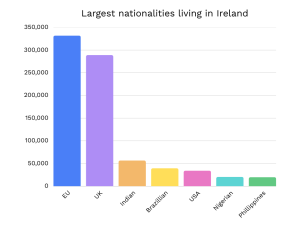
The majority of non-Irish citizens living in Ireland are UK or EU nationals availing of the right of freedom of movement (EU/EEA) and common travel area (UK) that all Irish citizens enjoy.
EU nationals living in Ireland 332,002
UK nationals living in Ireland 289,053
Apart from EU and UK nationals, below are the largest foreign-born communities living in Ireland:
Indian nationals living in Ireland 56,642
Brazilian nationals living in Ireland 39,556
USA nationals living in Ireland 34,236
Nigerian nationals living in Ireland 20,559
Philippines nationals living in Ireland 19,846
(CSO Census 2022)
Note: Since the 2022 census was taken, Russia illegally and brutally invaded Ukraine, and thousands of Ukrainians have sought refuge in Europe. As of February 2026, an estimated 84,100 Ukrainians live in Ireland under the EU’s Temporary Protection programme. Of these, 27% are under the age of 20, the vast majority of whom are school-going children.
How do non-UK and non-EU nationals come to Ireland?
The vast majority of people from outside the UK and EU who come to Ireland apply for and are granted work or study visas. 72% of all visas are issued for employment or education purposes. Other visas facilitate family members joining someone who is already lawfully in Ireland.
To secure a work visa you also need a work permit, only granted to economic sectors where there is a proven lack of locally available workers.
Are people seeking international protection (asylum) a large part of immigration to Ireland.
Not really. In 2023 the immigration services dealt with 167,000 visa applications. The number of asylum applications, by contrast, was only 13,000.
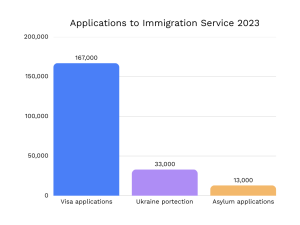 (Department of Taoiseach: Migration the Facts)
Economic Contribution of Migrants
We all know that certain sectors of the economy and our public services won’t function without the contribution of migrants.
People with a citizenship other than Irish accounted for 21% of all workers in Ireland in Q2 2025.
In 2024, 39,390 work permits were issued by the Department of Enterprise, Tourism and Employment.
32% of those permits were for essential workers in the health and social care sector, 8.5% of permits were for workers in our hospitality sector and 4% of permits were for workers in construction, who are vital for building the homes and the infrastructure we need.
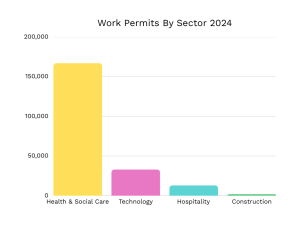
As the figures show, the health and social care sector in particular relies heavily on workers from abroad.
Nearly one in four nurses and midwives employed by the HSE come from abroad. 43% of our doctors were initially qualified outside of Ireland.
Ireland needs workers from abroad to be able to provide the essential public services we need and to ensure that our economy can continue to grow and provide quality employment.